Blog · Explainers
What does Atlas lineage mean, and why does every version of a site model name its parent?
An explainer on how Atlas keeps a living 3D model of a site honest: versions, parents, the observations behind each change and where the data lives, told through Nordvik Steel's Mill 1 model.
Atlas lineage is the rule that every version of a site model records which version it came from, which observations changed it, when it was trained and where it is stored. A plan made against version v41 can always be traced back to the Halo and Kinetic observations that shaped v41, and to v40 before it. That is what lets a safety case cite a model version rather than a drawing, and what lets an engineer see exactly what changed between two versions of the floor.
Soren Avelar · CTO, Sirdar Systems · · 4 min read
Last updated
What is an Atlas version?
A trained snapshot of the site, with a name, a parent and a record of what made it.
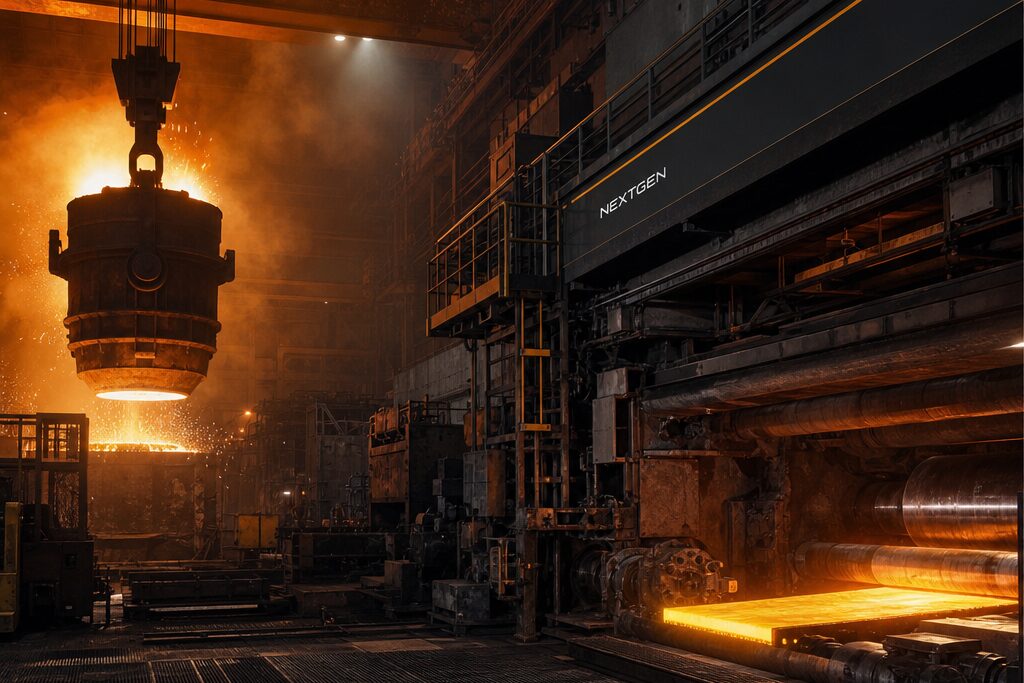
Atlas is a living 3D model of a site, learned from Halo and Kinetic observations. It does not update itself silently. New observations are gathered, a new version is trained from them and the previous version becomes its parent. Atlas Studio shows the chain.
At Nordvik Steel's Mill 1 the active version at the time of writing was v41, trained on 2026-09-25 from 2.3 million events, with v40 as its parent. Behind it sit v40 (2026-09-11), v39 (2026-08-28) and v38 (2026-08-14), each with its own event count and its own note on what changed.
Why does every version name its parent?
So that a change can be explained, not just observed.
A model that only shows the current floor can tell you where the coil-storage aisle is. A model with lineage can tell you that the aisle appeared in v41, that v40 had no geometry change (a seasonal lighting update), that v39 modelled the Furnace 2 outage scaffolding as temporary and that v38 was the baseline after the Q3 Halo calibration. When an engineer asks why the crane envelope changed, the answer is a version and a diff, not a guess.
What does a diff between two versions contain?
Four kinds of change, each with its source.
The v40 to v41 diff at Mill 1 lists:
- Added: coil-storage aisle K, 48 m × 9 m, 312 new occupancy cells.
- Changed: crane rail CR-2 elevation, +11 mm along 60 m after a Halo re-survey, with the envelope re-derived.
- Removed: the Furnace 2 scaffolding, a temporary structure cleared on 2026-09-19.
- Unchanged: the 14 Kinetic safety zones, all verified against v40.
The diff also names its sources: 1.72 million Halo H30 observations and 580,000 Kinetic M4 observations. Nothing in a version comes from a hand edit; if the floor changed, a sensor saw it change, and the diff says which one. Across 1,204,318 compared cells, 8,947 changed. That last line is the one safety engineers read first, because it bounds how much of the site the new version actually touched.
Why does an 11 mm change to a crane rail matter?
Because Kinetic plans against the envelope that rail defines.
A Kinetic M4 carries 25 kg at 1.4 m reach and moves at up to 1.6 m/s. The clearance between an arm and a structure is set in the model. If a re-survey moves a rail by 11 mm, the envelope is re-derived in the new version, and the safety zones are re-verified against it. The lineage shows when that happened and which observations justified it. Without it, a site would be trusting a drawing that was correct on the day it was drawn.
Where does the model data live?
Where the customer's policy says it must.
Every Atlas version carries a residency attribute. Mill 1's versions are all marked EU. On 2026-09-09 Atlas added EU residency controls, so a customer in Europe can require that training events and trained versions stay in the region. Residency is recorded on the version, next to its parent and its training date, so a compliance reviewer reads it from the same lineage view as everyone else.
How does lineage reach the safety case?
As a citation.
A signed safety case names the Atlas version the fleet's safety zones were verified against. When the floor changes, a new version is trained, the zones are re-verified and the case is revised. The case can cite v41 because v41 can explain itself. Meridian Freight, which runs Atlas with Aether across its connected sites, describes the result as one operating view across all its locations: a single model, with a history, rather than a set of plans that drift apart.
What should a buyer ask about any site model?
Three questions, whatever the vendor.
- Can you show me the previous version and tell me what changed?
- Which observations, from which sensors, drove the change?
- Where is each version stored, and can I pin it to a region?
If the answers are a version, a diff and a residency attribute, the model has lineage. Atlas Studio, in Atlas 1.4, answers all three on one screen.
Last updated 2026-09-30.
Questions and answers
- How often is a new Atlas version trained?
- When the site gives Atlas a reason. Mill 1's recent versions were trained roughly two weeks apart, each for a stated cause: a calibration, a scaffolding change, a lighting update, a new aisle.
- Does a new Atlas version invalidate the safety case?
- It triggers a revision. The safety zones are re-verified against the new version and the case is signed again citing it.
- Can Atlas data be kept inside the EU?
- Yes. Each version carries a residency attribute, and Atlas added EU residency controls on 2026-09-09. Nordvik Steel's Mill 1 versions are all marked EU.
- What feeds an Atlas model?
- Halo H30 observations and Kinetic M4 observations. The v41 diff at Mill 1 drew on 1.72 million Halo events and 580,000 Kinetic events.
- Is Atlas sold on its own?
- Atlas is metered separately from the hardware subscriptions, and customers such as Tanjung Terminals and Caledon Grid run Halo, Atlas and Sentinel without Kinetic.
#Atlas #World model #Data residency #Explainers
Related articles
Explainers
How does Sentinel protect operational technology on a robot site, and what does the EN-200 do?
An explainer on OT security the way Sirdar practises it: the five industrial protocols Sentinel reads, what the EN-200 edge node is, and how an investigation at Port of Halvard went from first observation to a proposed containment.
Soren Avelar · CTO, Sirdar Systems · · 4 min read
Explainers
What is a signed safety case, and why does a robot fleet need one before it runs unattended?
An explainer for buyers and site leaders: what a safety case contains, who signs it, which standards sit behind it and what changes on site once it is signed.
Minh Adebayo · Chief Safety Officer, Sirdar Systems · · 4 min read
Operations
How do you keep an installed fleet measured and protected? Sensor maintenance and site security after commissioning
What changes after the robots are in service: keeping Halo nodes calibrated, keeping the Atlas model current and keeping Sentinel watching the segments that matter.
Soren Avelar · Chief Technology Officer, Sirdar Systems · · 4 min read