Blog · Customer stories
How did Meridian Freight get one operating view across 38 sites?
A customer story: a freight network, a Premier-tier partner and all five Sirdar product lines, told through the three figures Meridian Freight reports and what sat behind each one.
Meridian Freight connected 38 sites to one operating view by running all five Sirdar product lines, Kinetic, Halo, Atlas, Aether and Sentinel, through a single partner of record, Granite Peak Technologies. The network reports 22% faster loading and 96% telemetry coverage. The operating view is Aether reading Atlas models fed by Halo, over a fleet protected by Sentinel, with one partner accountable for every site.
Marin Vale · CRO, Sirdar Systems · · 4 min read
Last updated
Who is Meridian Freight, and what was the problem?
A freight network with many hubs and, before Sirdar, many ways of seeing them.
Every hub had its own way of loading, its own reporting and its own idea of what a good shift looked like. The network director's goal was a single operating picture, not a dashboard of dashboards. Meridian Freight is one of the six customer stories Sirdar publishes, and the only one running every product line.
Why one partner for 38 sites?
Because one partner means one safety-case author, one commissioning standard and one phone number.
Granite Peak Technologies is the partner of record for the whole Meridian Freight estate. Sirdar sells only through partners, and on a multi-site deployment the choice of partner is the biggest decision the customer makes. A Premier-tier partner carries the Atlas Integration and Kinetic Deployment practices Meridian needed, so one organisation could survey, model, commission and support every hub the same way.
What does "one operating view" mean in practice?
Aether, reading the same kind of model at every hub.
Each Meridian hub carries Halo nodes that measure it, an Atlas model learned from those measurements and from the Kinetic units working the floor, and Aether agents that plan the shift against that model. Because every hub's model has the same structure and lineage, the network director can look at any hub and read it the same way. The quote Meridian gives Sirdar is exactly that: one operating view now connects all our locations.
The view is not a report built after the shift. It is the same Aether screen each hub's operators work from during the shift, so the figure the network director reads at noon is the one the hub supervisor released a dispatch against at ten past eight. There is no second version of the truth to reconcile.
Where did 22% faster loading come from?
From planning, not from faster robots.
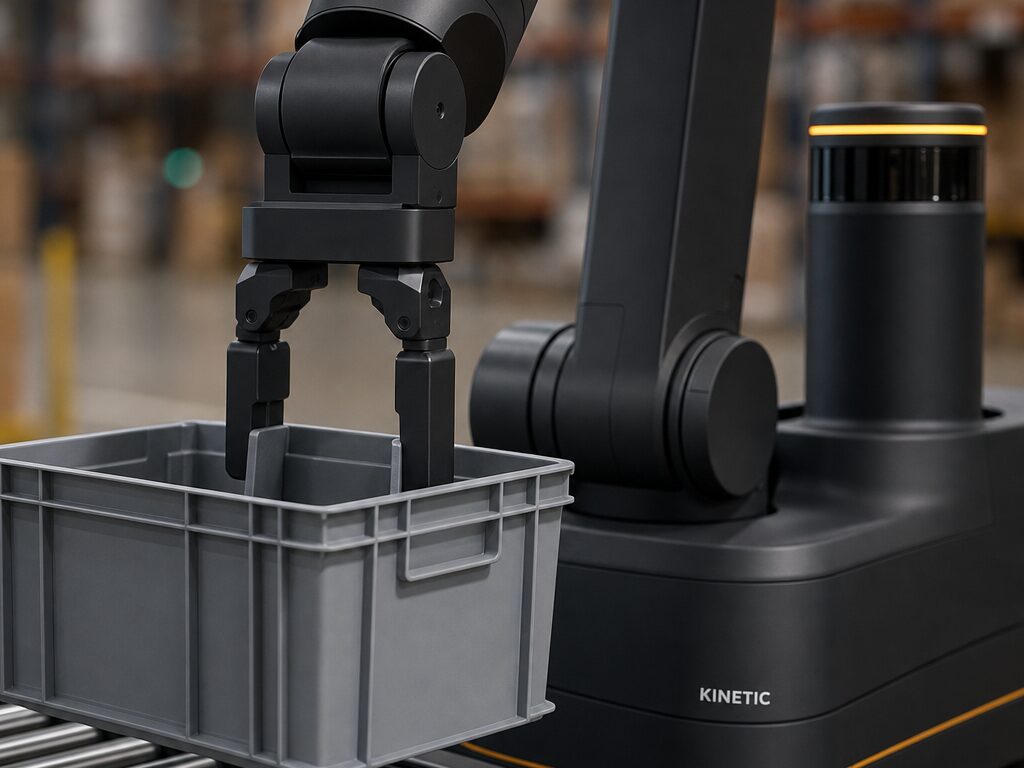
A Kinetic M4 moves at up to 1.6 m/s and carries 25 kg, which is useful but not the point. The gain came from Aether sequencing loading tasks against a model that knew where every tote and chassis was, and from exceptions being raised to an operator instead of stalling a lane. The partner's commissioning sequence, with Halo and Atlas in place before the first unit arrived, meant the planning layer had something accurate to plan against from day one.
What does 96% telemetry coverage measure?
The share of the estate that Sirdar and the partner can see.
Telemetry coverage is the fraction of installed units and nodes reporting into Halo Telemetry and the Sentinel console. At 96%, Granite Peak Technologies can see almost every device across 38 sites from one place, which is how a fleet this size stays maintained. The remaining share is largely devices mid-commissioning or in scheduled maintenance at any moment; the figure is a snapshot, and Meridian and the partner track it together.
How is a 38-site fleet kept secure?
The same way a one-site fleet is: Sentinel inside every unit, an EN-200 on every site network.
Meridian's Sentinel console shows Hub 12 among the sites Sirdar uses as references, with 6,218 protected endpoints and 141 OT assets, healthy at the time of writing. Scale changes the number of screens an analyst watches, not the policy. The partner's security desk works investigations across the estate, and a containment at one hub pauses only the units at that hub.
What would Meridian tell another network operator?
Three things, in the order the partner would say them.
- Pick the partner first. The partner's practices decide what the estate can become, and a partner that holds the Atlas Integration and Kinetic Deployment specializations can take a hub from survey to signed safety case without handing it off.
- Measure before you move. Halo and Atlas before Kinetic, at every site, so the planning layer is never guessing.
- Keep one view. If a hub cannot be read the same way as the others, it is not connected yet.
What is next for the estate?
More of the same, by design.
Adding a hub to Meridian's network is now a repeat of a commissioning sequence Granite Peak Technologies has run dozens of times, with a safety case written from the first quotation and signed before unattended operation. The network director's measure of success is unchanged: the new hub shows up in the same view as the other 38.
Last updated 2026-09-30.
Questions and answers
- Which Sirdar products does Meridian Freight run?
- All five: Kinetic, Halo, Atlas, Aether and Sentinel, across 38 connected sites, with Granite Peak Technologies as partner of record.
- What results does Meridian Freight report?
- 38 sites connected, 22% faster loading and 96% telemetry coverage.
- Why does a multi-site customer use one partner?
- One partner means one safety-case author, one commissioning standard and one accountable organisation across every site.
- Is Meridian's data visible to Sirdar?
- Telemetry and security data flow to the partner of record's consoles and to Sirdar's support under the customer's agreement; Atlas versions carry a residency attribute the customer sets.
#Customer story #Meridian Freight #Granite Peak Technologies #Aether
Related articles
Behind the scenes
What does an Aether operator actually approve during a day shift at a container terminal?
Behind the scenes on the Aether Ops screen at Port of Halvard Berth 3: the task queue, the exceptions the agents raise, the checks behind a proposed dispatch and where the human sits in every decision.
Sadia Morales · Chief Product Officer, Sirdar Systems · · 4 min read